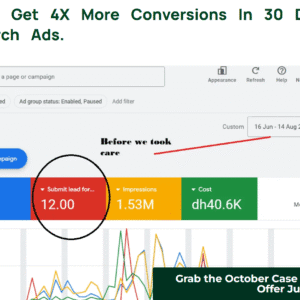
 October Case Study to 4x your conversions in 30 days
 Original price was: ₹599.00.₹99.00Current price is: ₹99.00.
✅Learn to design Landing pages which convert.
✅How to generate leads and sales from new Google Ads Account with ZERO history.
✅ How to optimize the correct signals to feed into Google Ads .
✅How we lowered CPL by 77% in 30 days.
Case Study: How We Scaled Finaxa Investments from 10 Leads in 2 Months → 40 Leads in 7 Days Using Google Ads
In this in-depth Google Ads case study, I break down exactly how Capability Digital overhauled the Finaxa Investments account — a Dubai-based premium investment company requiring AED 100,000 (~$27K USD) minimum investment — and turned a failing paid ads strategy into a compounding lead generation machine.
What You’ll Learn in This Video:
1. Landing Page Optimization (70% of Paid Ads Success)
2. Signals & Tracking (What You’re Asking Google to Optimize For)
3. Campaign Structure for New Accounts
Account Results: 📉 June–Aug 15: 10 leads (2 months) — optimizing for low-intent WhatsApp clicks 📈 September: 6 leads (1 month) — after overhauling signals + landing page 🚀 Next 7 days: 40 leads — after compounding all 3 pillars
3 Pillars Framework (Copy This for Any Account): ✅ Landing Page → ✅ Signals/Tracking → ✅ Campaign Structure.
00:00:02
Okay. So, this is a case study of Finaxa Investments. Okay. Uh this is the company. This is the landing page. And this case study is about it will cover three main things. One is a landing page. Okay. your landing page. And I’m not even going into product market fit, okay? That should always come first. Your landing page rules 70% of your paid ads success. Okay. There are no exceptions. Okay. Second, what we will cover is signaling. What signals are we feeding to Google or Meta? Okay. What are they what are we asking them to
00:01:04
optimize for? What are we asking Google to optimize for? That is the second uh point we will cover in this case study. The third is what campaigns are we running? Okay. And especially in a new account, what campaigns should we run? Okay. the safest one, the little risky one and a lot of risky ones and most of it depends on the budget and the expectations of the client. >> Okay. Now this is the landing page. Now to give you a context, this landing page was not like what it looks now. Okay.
00:01:48
This CTA, okay, it it is now made responsive. This CDA used to say contact us. Okay, this book a meeting. See it still goes down right down the page. There is a phone there. Okay, this request a call back which is a sticky side. This button used to do the same thing. It used to send the user right to the bottom of the page. Okay, UIUX very important in a landing page. We changed it to a standard request a call back form. Okay. And the black form, the black background with white text is completely intentional. Okay.
00:02:36
Now, uh before we go into the account, uh this Finaxa Investment, they are a company based out of Dubai. uh they basically uh ask for an investment of 100,000 dirhams. They are typically for middle class and rich people. Okay, people who have 100,000 dhams to actually invest, beat inflation, grow their wealth and grow their portfolio. Okay. And there are three main vehicles of investment is blue sky jets, rail property. So this is basically chartered flights. This is uh uh commercial property mostly commercial uh commercial
00:03:27
property and uh finex investments is into commodities. Okay, gold, silver and copper. Okay, those are the three uh commodities. So basically you beat inflation, you uh hedge uh against inflation, you grow your portfolio and you uh grow your wealth as well. Okay. Uh so if you see the mobile version of this page, uh sorry about this because uh this because uh this plug-in has a new update. So, okay. So, if you see the mobile version of the page, uh this was the version which I was so obsessed about. Okay. So, if you
00:04:22
are in performance marketing, you have to be obsessed about landing page. Okay? If your landing page performs, you do good. If your landing page doesn’t, if it looks like crap, it’s doesn’t matter what campaigns you run, it’s not going to work. Okay. So, okay. So, if you see if you see the this thing the mobile version again start investing today, it goes to the same form. Request a call back. Same form. Okay. And uh then this request a call back is side sticky. And then we have so
00:05:03
all this content was was arranged in a proper way. Okay. And now it looks much better. Okay. So it says there was a wall of text here about us. Okay. So this was broken down into bullet points. Uh this was again a wall of text here. It was broken down into bullet points. Regular income. So all these was made streamlined so that it it improves the UIUX. Okay. So number one is landing page. Okay. Very very important. And then we have the FAQ. So number one is landing page. It has to be in the flow. It the
00:05:45
flow of the landing page is superior. Okay. Than what content you actually have on the landing page. Okay. because this uh landing page has content which is also there in the actual website of this company. Okay, it doesn’t matter. Okay, what matters is how the content interacts with the user, how the user interacts with the content and takes action. Okay. So, uh and and if you see this landing page, it is uh it only sticks to three colors. Okay. Gold, black, and white. Okay. Apart from this photos which I asked
00:06:37
them to remove but for some reason they haven’t done it. But you see gold, black, white. Those are the three colors in this landing page. There you will find no other colors. Okay? Why? Because your landing page should correspond to the color themes of the industry or the product or the service you are selling. Okay, this is so important. A lot of performance marketers, web designers, they miss this point. Okay, this is a premium investment company. Okay, they are asking for 100,000 dirhams for
00:07:24
crying out loud. Okay, 100,000 dhams. uh if you if if you if you want context uh uh 100,000 dham is around 24 lakh Indian rupees investment okay if you want in USD uh it is like almost the same okay so it’s 27 uh uh 27 so it’s um I mean not the same But uh the value is $27,000 of investment. Okay? Like 27K. So it’s it’s not a small amount. Okay? So it’s premium investment. Whenever you you you are selling something a service or a product which is premium, you want it to be premium. You want the
00:08:20
perception. [clears throat] Sorry. You want the perception to be to be premium. Stick to black and white. And the third color should be according to the exact uh product or service you are selling. Okay. Black is the staple color for premium. Okay. Black is a staple color for premium. And the best color for text on a black background is straight away white. Okay. So that’s why this is black and white. And this is what I made them specifically change every color. They had blue uh buttons and they had like uh they were using a
00:09:09
second color. Okay. Or a fourth color. Okay. And I and I changed it. I asked them to use only these three colors. uh black being the staple color for uh premiums. Okay. Anything which is premium priced should use a lot of black. Okay. Black background. Okay. That gives the perception of premium. Remember your landing page is selling us something to the user who lands on the page. So the perception has to match. Okay? If the perception doesn’t match, your campaigns will not work. Simple as that. Okay. So, black and white. And
00:09:53
then you have we have this gold because the logo luckily had the gold color which is again another color for premium. Okay. But here’s a catch. The gold color looks specifically good and eye-catching on a black background. Okay. So that’s why this worked. Okay. Uh if their logo was any other color like blue or teal or something like that, I would have asked them not to use that color throughout the page. Okay. So this is a template you should have when you are designing a landing page or when you are getting the
00:10:40
landing page designed for your paid campaign. Guys, please understand this, okay? Your landing page is 70% of what you do. Your campaigns on the dashboard, they are just the 30%. If your landing page looks like a mule, it doesn’t matter if your Google ads is a racehorse, you will not get results. Okay? Your landing page needs to be far better than you whatever campaigns you’re running. Simple as that. Okay? Because your landing page rules 70% 70% of what you do. Okay? So if you are not designing your own landing page, okay, I
00:11:31
always design my own landing page. But if you are not designing your own landing page, make sure you have complete control on the landing page. It means you have to dictate. You need to dictate literally. Okay? You need to dictate what is shown on that page. What? How is shown on the page? You have to dictate that. If you don’t dictate that, okay, if your client says that no, no, this is this you just run the campaign uh leave the landing page to us. No, that’s a red flag. It means your client
00:12:12
if you are a freelancer client if you if you are if you are doing a full-time job then it’s your manager or the management or the leadership whoever it is they don’t understand this concept okay your landing page needs to be very very good convert the traffic okay and there is a reason why I’m repeating this I keep repeating this throughout my videos because I I’ve seen lots of examples where the campaigns are running fine on the dashboard but it’s not getting results because a landing page is a
00:12:50
complete mute. Okay. So, uh please keep that in mind. Okay. Now, uh okay. So, switching back to the desktop version and uh like uh there is something wrong. Okay. Okay. So, you have to dictate what happens on the landing page, what is shown on the landing page and how it is shown on the landing page. You have to dictate that campaign. Now, we’ll go to the uh to the actual campaign. So, we covered the first point is the landing page. Okay. So again to sum up the uh to sum up the landing page part of
00:13:46
this case study, if your if your uh product or service is perceived as premium, always go for black color. Black color and white text. Okay, black should be the background. Basically, black should be the majority color used on the landing page. Okay? And of course, white becomes the obvious choice for text. Okay? And then use a color like golden yellow. Okay? Like this color here, golden yellow. And coincidentally, this logo was also golden by default. So, it saved us a lot of time. Okay? So stick with this. If
00:14:36
your this is if your service is a premium one, then go for black, gold, yellow and white, okay? Black being the majority. If your service is a tech service, okay, a tech heavy service, okay, something like B2B SAS or you know even normal SAS, okay, you are selling AI agents, use a lot of blue color, okay, navy blue, you can also go for teal blue, but majorly navy blue and blue overall because blue is a color for tech. If your product is if your product or service is related to education, try to use a lot of yellow and green.
00:15:32
Okay, yellow and green are very good combo for education. And try to use a majority of white. Okay, even for tech SAS uh or even any kind of tech landing pages, never use black. Okay, do not use black. Use white as a background. White should be the majority and then everything else you do like especially the CTA color, the the text font, okay, the you know the text and all should be the text CTA is the major thing which counts. So on a white background [clears throat] you should be using blue and uh the shades of blue that those
00:16:17
stand for tech. If you are ed ed if you are education product or education service go for a majority again you can go for a yellow background or a white background but try to use a lot of green for the CTAs and uh you know green and again yellow okay but not the golden yellow golden yellow is premium use the other yellow uh shades shades of yellow okay if your product or service is something related to food or uh B2C or medicine. Okay. Right now I’m just clubbing all this into one. Okay. Uh because I just
00:17:06
want to go through this uh landing page uh part quite quickly. If your product falls into this food medicine, alternative alternative medicine, okay, then go for majorly go for green. Okay, so there should be a lot of green used on in the landing page and then go for a little bit of uh pink and uh but use shades of pink and orange. Okay, orange because that’s what works on a green background or you can use a white background and use green CTAs and uh text should you can go for uh orange or pink. Okay, the reason why I’m telling
00:17:55
you this is because there these are major guidelines of how to design landing pages the color templates. Okay, at the end of the day, your brand or the client you will work for will also have their own brand color template anyways. [clears throat] So again, you have to stick to that. So these guidelines will help you make landing pages for clients and help you avoid some of the mistakes that you know uh people do. Okay. So [clears throat] coming back to the the this case study. So first point is landing page is done.
00:18:37
Now the second is signals. Okay. Now now this is something which will be very very interesting. So you see this uh this account was started on 16th of June 2025. Before that it didn’t exist which means this is a fairly new account. Okay, fairly new account. Now I was not handling this account when it was started. Okay, I came into the picture somewhere around mid August or end of August. Okay. So it has been like two months now that I’m handling this. So before that if I show you the numbers
00:19:28
which is very very interesting. So I show you let’s say till uh till 15th of August. Okay. So all the way from June to 15th of August you see you see how how many conversions were there like 7,400 something crazy conversions. It costs only five DS, right? When you actually go into the account and look at the campaigns, what was happening was you see WhatsApp click 496, WhatsApp click 6528. Okay. WhatsApp trick 298. Okay. So what was happening is the person who was handling this account uh she was under the impression and not
00:20:19
only she uh the client PC was literally forcing her to get results like from tomorrow. So what she did was now you won’t see that on the page but there was actually a WhatsApp button here and somebody clicks on that and the WhatsApp used to open up like it happens and that’s the button where she put a lot of effort and Google started optimizing for that WhatsApp button click. Okay. Now always remember this machine learning AI will always take the easiest route. It will always take the path of least
00:21:04
resistance. Always always always. So that is why and if if the goal is too hard. Okay. Like for example this is one extreme where the goal of the uh the machine learning was asked to optimize for something which was too easy and too low in debt. Okay, like somebody clicking on a WhatsApp button that is very low intent. Okay, people uh people didn’t even have 100,000 or anywhere close to that. Okay, so that is one extreme. The other extreme will be if you ask the machine learning to sell products of like $200
00:21:49
something like that. Okay. Or if you talk in Indian rupees, let’s say you ask it to sell something for like uh let’s say 5,000 rupees, okay? Or 4le 9, okay? Or 2le 9, okay? Especially with a new account, okay, these are two extremes where the machine learning will completely fail you. Okay, if you give it something too easy to do, which is obviously low intent, which is exactly why it is too easy to do, then the machine learning will give you a lot of crap. Okay? And it won’t help you.
00:22:27
That’s what happened with this account. Okay? they were getting so many WhatsApp clicks and almost all of them were almost like 90% of the leads the client said when they didn’t didn’t know that uh you know uh 100,000 dirhams they they have never seen 100,000 dirhams that was the point okay because the the the goal for which the machine learning was asked to optimize for was very low doing. Okay. Now, if on the other extreme, if you go for something which is very hard to do. Okay. Now, I’m
00:23:07
talking of new accounts. I’m not talking of old existing accounts where they have a lot of data. Okay? There are a lot of existing D2C e-commerce clients who have thousands of conversion data where they are easily selling something uh some products of 2,000 5,000 rupees daily. Okay? That’s a different scenario. I’m talking about new accounts. Okay. So with new accounts if the goal is too easy or the goal is too hard in both of these your the machine learning will fail. Okay. In one case it will give you
00:23:40
a lot of crap. In the other case it will not give you anything. Okay. It will be super hard to get a conversion in the first place. So [clears throat] with a new account, the signal that you feed into Google, the signal or the goal should be something which is somewhere in the middle. Okay? It should not be too hard but it should not be too easy. At the same time, it should also fulfill the business purpose. Okay? So which is why you see post when we when uh we took this account from capability digital we took
00:24:22
this account like the the lady who who was working previously she’s still working with us uh but we kind of handle the Google account. Okay. So uh you see here from 16th to let’s say the the the first 15 days was where we were testing. Okay, we were testing. So you see now you won’t see any WhatsApp clicks. You will see submit lead form which is basically submission of this lead form. Okay. Now this form still needs a little bit of work and this is still work in progress but uh this why did you hear
00:25:07
about us like there is no point and message these two are actually optional but they are never marked as optional okay name email ID phone number and this thing these are all mandatory fields the first four fields are mandatory and I asked them to specifically remove these two fields okay so this is still work in progress just FYI So uh so if you see August you will see we were testing and there was only one lead. That’s fine because from June to August 15th the client got only 10 leads. Okay 10.
00:25:51
They got thousands of WhatsApp clicks which were all crap but they got 10 leads. Two months. Two months they got 10 leads. Actually it’s June, July, August. Yeah. Two months they got 10 leads. When we started overhauling this account, okay, pushing out the WhatsApp click. Okay. In 15 days they got one lead. Okay. So basically uh okay like not a huge sample to work on. Now you see September September there are six leads six leads in September that’s when things slowly started picking up. [clears throat]
00:26:37
Okay. Now if you are wondering why the campaigns are paused now is because the the client has asked us to uh go for they they are having some problems with the payment uh the payment or you see new form of payment required right so they’re having some problems with the bank with the local uh uh UAE bank uh which is why they have asked us to was and as soon as the bank issue gets sorted out we will again go live with the campus but here’s the point see in September six leads okay this is all dashboard data okay I
00:27:20
we can’t make this up okay so again signaling so if you see from August 15th when capability digital actually started handling the account we just completely removed moved that low intent goal which Google was initially optimizing for. Okay, that is important. This is our second module in this case study today is not exactly module but this is our second point in this case study is signals. What are you asking Google or Meta to optimize for? If you are asking Google and Meta to optimize for landing page views, which is a low
00:28:03
intent goal, then you will get all visits. If you ask Google and Meta to optimize for let’s say add to cart, okay, that is still a little bit higher intent. Okay. But if you ask it to optimize for let’s say uh something like view product info that is low intent. If you ask Google to optimize for add to cardart it means at least that person has some intent. Okay. And then once you keep have once you accumulate a lot of add to cards and then you your purchases actually trickle down then you can
00:28:50
slowly shift to a higher intent goal which completely aligns with your business. Okay something like a purchase. Okay. But when it comes to lead generation things get a little bit complicated because there is something called the turnaround time. the tact the leads go to the sales team. The sales team call those leads and then they come back hey all your leads are crap. Okay. So maintaining quality in lead generation is a little bit tricky but it can be done if it is done using expedit. Okay. So if you see if you see now in
00:29:32
September we had six leads. This was when whatever campaigns capability set here and is basically Mihi was setting this campaigns uh it has actually started working because 2 months 10 leads 1 month six leads that’s a huge improvement. Okay. So, and now if you see this month, uh we just paused the campus today because of this bank issue thing. But if you see this month, 40 leads 40. Actually, it’s more than 40. No, 40 leads. Okay. In just 7 days. That’s how the thing compounds because now Google
00:30:16
knows like we can get leads. Previously, Google was just spoiled using WhatsApp clicks. Then we removed the WhatsApp clicks. That’s the chronology. Okay, we removed the low intent completely. Forced Google to optimize for lead submissions, lead form submissions. Lead form submit. Okay, forced it. At the same time, we were also working on the landing page. Okay, the one which I described in the initial starting of this case study is we worked on the landing page how to get more lead form submits which is we organized the UIUX
00:31:03
we made the this form appear everywhere okay like everywhere on the they still have this like this is complete uh BS but this form was appearing everywhere okay uh Especially on the mobile version which I showed you earlier. Okay, this uh we changed the CTAs. Okay, we changed the CTAs. Okay, previously the CTA was contact us. Now start investing today. So your CTA in the first above the fold has to be a actionoriented CPA. Previously it was contact us. It’s lame. Start investing now. Straightforward
00:31:46
start investing. Okay. So it filters that intent which in turn goes back to Google saying that hey these people they they have no intention of filling this form. So it’s best that we don’t even go out to such people. Okay. So that is how the whole thing compounds. Okay. So first two months. So just to recap what happened with this account is first two months there were 10 leads, next month there were six leads and now there are 40 leads. Look at the growth. Okay. So this is what happens when you
00:32:33
follow the template. Landing page, signals and then campaigns. Three three pillars of this case study which you can copy and implement it in any account that you are working on. Okay. Landing page, signal and campaign. Okay. Now signal by the way also includes tracking. So which means everything needs to track correctly. Okay. And for tracking I suggest use tag manager, Google tag manager. Do not use Google Analytics because Google Analytics is actually meant to look at analytics data. It is not meant for tracking. Okay. But I see
00:33:23
many performance marketers make this mistake over and over again is they it’s it’s just easier to use Google Analytics for tracking but there is a price you pay for something which is very easy which is it is faulty. Okay. It counts one conversion as five or six. Okay. And so it completely gives a wrong picture to Google what to optimize for. So tag manager is lot more accurate. Tag manager was actually meant to tag and track. Okay. So that’s like the difference between uh German shepherd
00:34:04
and a golden retriever. Okay. The German shepherd is meant to guard track and do stuff. Okay. Like seriously. Okay. That’s your tag manager, your GTM, your tag manager. Your Google Analytics is your golden retriever. Okay? It is playful all the time. It does stuff which makes you laugh. Okay? It does all the things which is funny, but it is not meant for doing serious stuff. Okay. Okay. So, [clears throat] that’s just an analogy. uh um I hope it drives the point. Okay. So we covered the second point which is signals. Now
00:34:53
we come to the third point which is what campaigns to run new new account. Okay. This is relatively a new account but there is basically no data uh before June. Okay. So what what campaigns to run. So now please understand this before I go into the campaigns. Your campaigns will perform like this only if your other two pillars are working solid. Please understand this and I’m repeating this. Your campaigns will work only when your landing pages and tracking and signaling. Basically, it’s tracking/s
00:35:37
signaling is up to the mark. If any of these two doesn’t work correctly, then it doesn’t matter what campaigns you’re running. Even if you are running only search, it will never work. Okay. Now, new new accounts. So, what do we do with new accounts? Basically, what we did here was search campaigns. They are the best bet to start with. Okay. Now if you see we had a search campaign on maximize dicks and then we have a experiment a Google experiment with broad only okay now I’ll show you
00:36:22
what we did. So normally when you uh I will show you the maximize clicks campaign what keywords and all. So when you go for maximize clicks remember Google is trying to maximize the clicks for a budget. Okay Google is trying to maximize the clicks for a budget. Okay. So when Google tries to maximize clicks, do not give it too much room to work with. Okay? What I’m trying to say is if you’re using maximize clicks, stick to exact match. Okay? Especially for new accounts. Okay? Exact match plus
00:37:08
maximize sticks. That’s your winning combo for a new account. Okay? Now if you see here what we did was uh just a second because the Google dashboard has become so confusing that it so where is the maximize click test? So this is the campaign. Okay. And I go into the keywords. So if you see all the keywords there are how many keywords now? 36. 36 keywords. All of them are exact match. All of them. Okay. Like I can prove it now. Match type broad nothing. Phrase nothing. Only exact. That’s your winning combo. Maximize
00:38:02
clicks plus exact match. And if you see uh there are a lot of longtail exact as well because we have to take care of something which are close variants. Okay. So let’s say exact match like like I I can pull up the one which spent the most. Uh okay. So it’s already filtered that way. How to invest in gold. Okay. If I look into the search terms just for fun. how to so I’m looking into only one keyword and I’m looking into all the search terms which are triggered from that keyword only the keyword was how to
00:38:47
invest in gold right so if you see the search terms how to invest in gold which is the exact match then best way to buy gold for investment close variant buy gold investment close variant buying gold for investment close variant gold as an investment closed variant. Okay, gold investment closed variant. Gold investment options closed variant. So this is the reason why I said when you start with maximize clicks, use only exact match. Do not use phrase match and never use broad match. You will literally die in the middle of the feed.
00:39:25
Okay. So So this this is how you start a new account. Okay. Uh let’s go back to the keywords. Uh and there’s also something that I need to point out here is this is the seed campaign. Okay. This is the base campaign. The base campaign was exact match plus maximize clicks. If you look into the audience, the audience is intentionally set from 35 all the way up to 64 years of age. No 18 to 24, no 25 to 34 and no 65 plus. Why? Because you need 100,000 dirhams investment. Of course, nobody in the age group of 18 to 24 will
00:40:17
have that kind of money unless his dad is a billionaire which is like not even 1% of the population. Okay? like billionaire kids not even 1% of the population then 25 to 34 why did we exclude this because people in this age group they are actually trying to get stabilized in their carrier okay they have still they they they are still trying to decide what carrier is best for them so obviously they won’t have a corpus of 100,000s Okay. Uh, [clears throat] so the best age group is 35 to 44 and I
00:41:05
think majority of the leads came from here if I’m not wrong. Uh, okay. Uh, okay. And so uh 35 to 44. Okay. 45 to 54. These are actually the major cash cows for this uh in uh for this company. Okay, remember 100,000 Dams is 25 lakhs in Indian rupees and 27,000 in USD. Okay. So this is like 45 to 54 and 55 to 64. So 55 to 64 we kept it because we wanted to have all the CEOs and the senior leadership of companies. Okay. and people who are running their own business and entrepreneurs. Okay. So, first generation, second generation
00:42:00
entrepreneurs, we wanted to have them. So, 55 to 64, that is the logic behind keeping this age group. Above 65 plus, they are most likely on the retirement bonus or retirement money. So, they won’t usually take the risk of $100,000. They may but the probability becomes less. Okay. And unknown is basically uh incognito. Okay. So this is the this is the seed campaign. Okay. This was a base campaign. Okay. Now what did we do to scale this up? We took an experiment. So I’m just showing you how to do the
00:42:44
experiment. I’m sure most of you know. But when you do experiments there are a lot of flexibility. Google gives you a lot of flexibility to do experiments. Okay. So I always go for custom experiment. Okay. And the custom experiment is basically it’s a 7030 split. So basically 70 is the base campaign. 30% of the budget daily budget is a treatment campaign. Okay. And uh the sync status is off which means the sync of this campaign with the base campaign is off. You can keep it on. Okay. I just kept it off because there
00:43:27
is just one campaign so I can handle that manually. Okay. And then the most important thing is when you do the split type, okay, when you set the campaign, set the experiment, there’s something called the split type. Never go for cookie split. Cookie split. No. Strict no. Strict no for cookie split. Always go for search split. Why? Because a cookie split audience between your base and your main campaign. Uh your base and your expment campaign is basically people who will see the uh keywords.
00:44:09
People who will be targeted by the base campaign will never be targeted by the treatment campaign or the experiment campaign and it is not ideal. Okay, you can say yeah that’s what a AB test looks like. We are not doing AB tests. Okay, AB tests the age for AB tests are gone. AB tests are dinosaurs now. Never do AB tests. Go for split testing, but always have the flow. Which means people who are targeted by this exact match campaign should also see ads from the broad match campaign. Why? Because this will bring in intent.
00:45:00
Uh sorry, this will bring in uh targeted audience. Broad will give it intent. Okay. And then when both the things mix together then we get conversions. So your broad will always get more conversions. Okay. That’s a fact. Your broad will always get a get conversion. So we are not trying to uh when we set up a Google experiment the objective of the Google experiment is not this versus this like this is winning and this is losing. No that’s an AB test. age of AB test is gone. Never do AB tests. There’s
00:45:41
a it’s a waste of money and a waste of energy. Okay? It’s not this versus this. It’s incremental. Okay? The idea of Google experiments is incremental. Which means my base my base campaign is targeting only exact match and then I am splitting 30% of this budget for a broad campaign and see if this broad can scale audience from the base campaign. That’s the that’s the uh you know that’s the objective of a Google experiment and that is why this works. Okay. So remember the split type
00:46:24
never choose cookie split always choose search based split. Okay. Now uh and the rest is usually you follow the prompt. So this if you see if you see this campaign the broad only campaign this keyword was the all these keywords were broad all of them. And how many keywords were there? They were doing 27. Okay. Now, if you go into audience and see which ones actually worked, it is surprising to see all of them came from unknown. Uh but I wouldn’t be surprised. Yeah, all of them came from unknown and all of
00:47:09
them came from real estate investment. Okay, which is a good thing. that there’s nothing to be alarmed about because unknown is and uh there’s also a reason why I chose sync off is because I can switch off something in the experiment campaign and the base campaign will remain unaffected. Okay, there will be no changes in the base campaign and vice versa. If I change a small thing in the base campaign, I don’t have to worry about my uh uh you know my experiment campaign reflecting the same change unless it’s a big
00:47:45
change. Okay, but there were no big changes which are needed. So this is fine, right? So yeah, so I think that concludes our case study. Okay, uh if you are running a new account and especially if it’s needed gen uh even This is a e-commerce account and you are trying to sell products. Okay. Uh first get your product market fit right. So I’m so this is recap of the entire case study. Get your product market fit right. Okay that’s very very important much more important than what camps you
00:48:25
are at. Get your product market fit right. which means uh you don’t your price of your product should match the people that you’re actually targeting. Okay. Uh and then uh go for and then look at the landing page. So your landing page should convert. That is the main thing. Your landing page should convert. If your landing page cannot convert then your paid campaigns will not work because it doesn’t matter how much budget do you have. Okay. And then you are the one who have who have to go
00:49:02
back and explain to the leadership why your paid campaigns are not performing that well. Okay. The reason is your landing page. It is not your campaigns. Okay. So number one is a product market fit which is which is outside the scope of this case study but I I will do it at a future date. Uh so the number one thing which we discussed was the landing page design. Okay remember we spoke about different color themes of landing pages in different industries. Okay. Then there’s a also thing called font
00:49:39
families. Okay. So I don’t want to get into that because it’s going to be long but uh font families is something that you can ask Chad GPT that my product or services this industry this product what should be the font family exactly this is the prompt you need to ask chad GPD and chad GPD will give you pretty accurate answers because it has data about landing pages and all the things okay so usually if it’s something related to tech or uh education, JPT will always ask you to use Mandro,
00:50:21
Monserat and Inter if it is something uh like premium service. Chat GPD will ask you to use poppins, bold poppins and uh there are two other uh font families which I I cannot remember exactly. If uh your uh you know uh and then there are like there are like there are colors which we discussed then there are font families which apply to specific industries and specific products. Okay. So this is this is the landing page part. Okay. The first part is a landing page. Okay. The color theme, the the the
00:51:07
flow of the landing page, the CTAs, the color of the CTAs, the font families, everything is important on the landing page. The second is the signaling. So what goal are you asking Google or Meta to optimize for? That is important. And signaling also includes tracking. So everything should track correctly. Okay. Everything should track correctly. Use GTM and use server tracking. So uh server to server tracking is very easy to set up. You can use a tool called Cappy. Okay. Cabi Cappy. Uh it is very
00:51:46
easy to set up and it is very cheap. It just costs you $10 per month to set up server tracking throughout. Okay. It works for Meta, it works for Google, it works for every other uh uh tool that you that you can think of in advertising. Okay. And uh it also gives you a domain uh a free domain to use, a free subdomain which you need to use for server tracking. So you don’t have to pay Google $150 for a separate subdomain. So it it makes things a lot more easier and is very easy to set up. Use server tracking make a separate
00:52:26
server container in GTM and use that for server tracking. So what I’m trying to say is when it comes to the second part of signaling it is the goals as well as the tracking and for tracking use both web based and server based use both of them. Okay? which means you make separate containers for web and server. The third is uh the campaign. So if it’s a new campaign uh it is best to start with exact match plus maximize clicks to get more information. And this is also a time to understand what is the conversion rate
00:53:09
of your landing page. Okay, if your conversion rate is not good, it’s not the campaign which is a problem. Go back to the landing page. Go back to the UX. Okay, take a screenshot of the landing page. Post it on Chad GPT and exactly, you know, exactly use this prompt on Chad GPT. What sucks on this landing page? Okay, I’m not trying to use profanity. I’m just trying to tell you that with Charpt uh all these LLMs are designed to be diplomatic. Okay, they will always sweet talk you. Okay, so if you post the
00:53:48
entire full page screenshot of your landing page and ask Chad Guty, hey, what is wrong with it? Chat duty will probably point out the good stuff and then the bad stuff and that won’t give you a clear picture. So when you want a good CRO audit of your landing page and this is actually something which I’m adding to this case study right now. Uh uh I will make a separate case study with charg prompts which I use from day to day. Uh if you see my uh my chart GPT this is how it looks. Okay. So like it
00:54:28
is full of uh things. So um but if you want a real blunt CRO audit of your landing page, take the entire full page screenshot of your landing page and post it into Charge GPD and exactly write this. What sucks on this landing page? What sucks on this landing page? And Chibdy will literally give you so many points to work on, okay? that even if you implement half of it your CRO your conversion rate optimization okay will improve by 50% 50%. Okay. Okay. So yeah, so I think that concludes our case study and which is a landing
00:55:17
page signaling and campaigns and then once you set up the campaign the exact match and the maximize clicks then you uh after a few days then you set up the experiment with broad but it’s an optional step. If your client is pushing for too much results in a short period of time then do that and uh always give this broad arm of this search campaign only 20 to 30% of the budget. Google will force you to give 50% of the budget. Never do that. Okay? Even if you have thousands of dollars to burn every day, never never do that.
00:56:01
Give it only 20 to 30%. 20% is ideal. 30% is when you can take a risk. Okay? So yeah. So that that’s it. That’s the conclusion of our case study. Uh thank you for uh taking this case study. I’m sure you will be able to implement this template in your Google ads specifically, especially for Premium Leadgen.
Built by a Google Ads Specialist Who Has Managed ₹233Cr+ in Spend
Before
Leads: 12
Cost per lead: 40.6 AED
Impressions: 1.53M
After
Leads: 48
Cost per lead: 9.07 AED
Impressions: 95K
This campaign started from scratch – NO old data NO Account history, NO warm audience.
Here’s how we structured and optimized everything in 3 simple stages:
Landing page CRO → Google Ads Signal Optimization → Scaling.
 October Case Study to 4x your conversions in 30 days