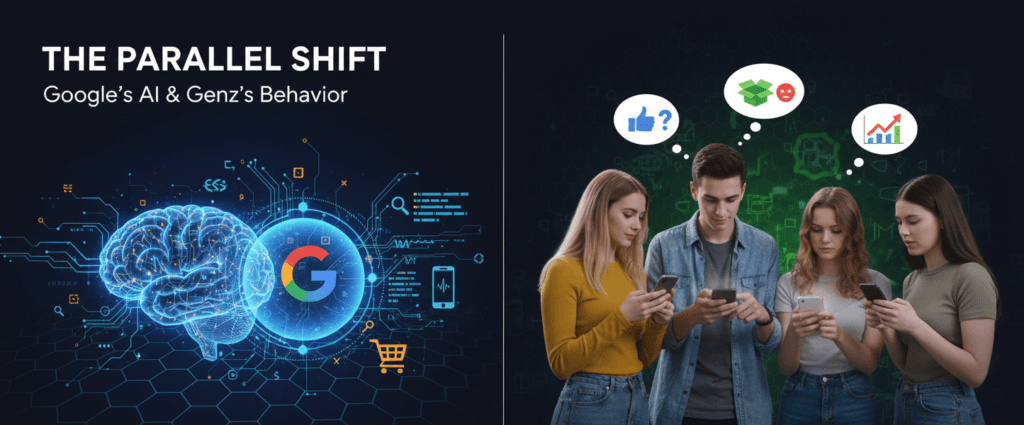
There is surprisingly little direct analysis on how Gen Z is reshaping Google Ads. Thought leaders circle the topic, but rarely address it head on. Meanwhile, Google has steadily shifted how search advertising works: expanding close variants, making broad match smarter, and diluting the meaning of exact match. These shifts align with how the new generation searches and evaluates information. Gen Z, now entering evaluator roles and approaching decision-making positions, is at the center of this change.
The Parallel Shift: Google’s Controls and Gen Z’s Behavior
Over the years, Google has moved control away from advertisers toward machine learning. With billions of data points, Google often suggests that handing over a URL, product feed, and a credit card can be enough. At the same time, Gen Z trusts traditional search less due to ad saturation. They were born into smartphones, not dial-up or button phones. The internet, for them, is an always-on experience with abundant information on any topic.
This abundance shapes how they evaluate brands. While exact match and manual precision still have tactical value, scale increasingly requires smart bidding, signals, and machine learning. If your goal is to reduce CAC and grow, you end up leaning on automation.
The Zero-Click Generation
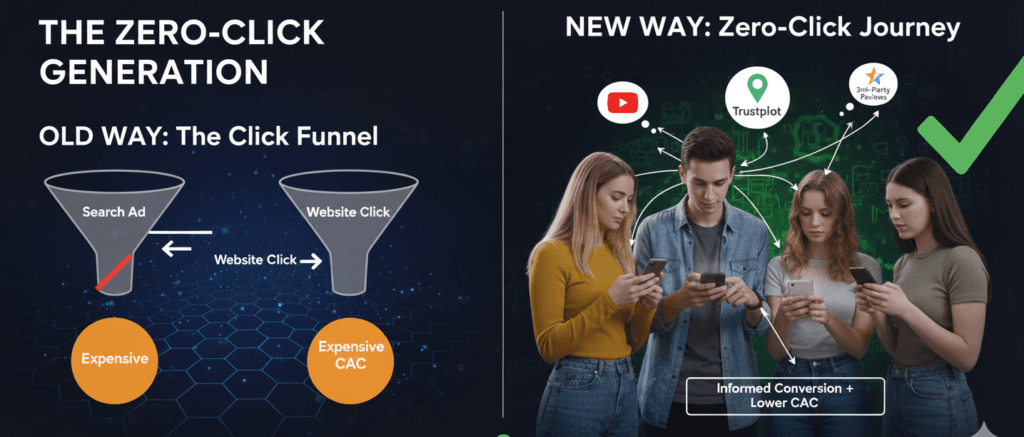
In many accounts, particularly in B2B and B2C, we are seeing that some can now operate without a dedicated search campaign. It sounds counterintuitive, but when we turn off search and run Demand Gen, then layer in Performance Max later, it often does not feel like anything is missing.
A core reason is behavior. Gen Z has been exposed to ads from childhood and is less likely to click. Many performance marketers now describe them as a zero-click generation. They notice brand names and products, then research independently. They check YouTube for reviews, Google Business Profiles, and third-party review platforms like Sitejabber and Trustpilot before engaging. The evaluation happens upstream, not after the first ad click.
Gen Z Has Moved Up the Funnel
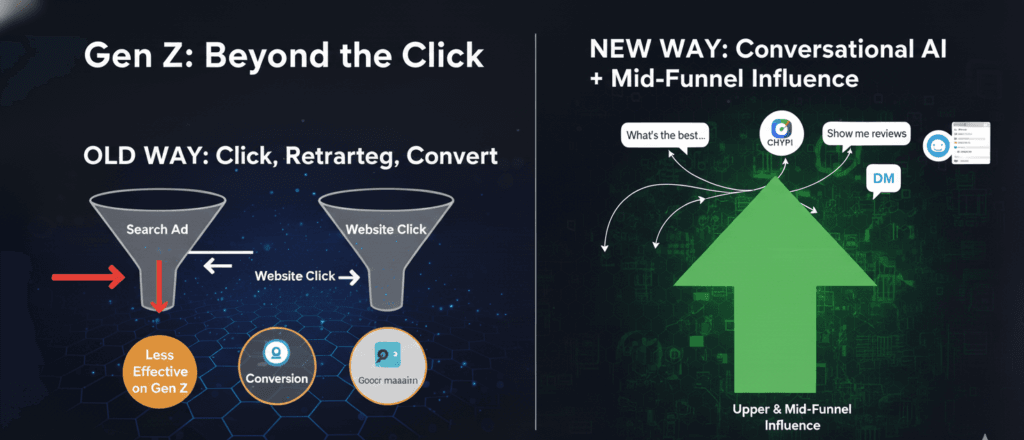
Relying on the classic model of click, retarget, convert is less effective. Gen Z’s evaluation process has shifted up the funnel. In parallel, Google’s product roadmap appears to align with this. Conversational ads are emerging, blending native Demand Gen with the feel of DMs and chats, powered by AI. This reflects broader behavior changes where Gen Z increasingly uses tools like ChatGPT, Grok, Perplexity, or Gemini alongside or instead of traditional search. They still search, but click less on ads.
When the cohort clicking least becomes the cohort evaluating most, the performance playbook changes. Bottom-funnel search alone is no longer enough. Upper and mid-funnel influence becomes essential.
Rethinking Channel Mix: Demand Gen as a Base Layer
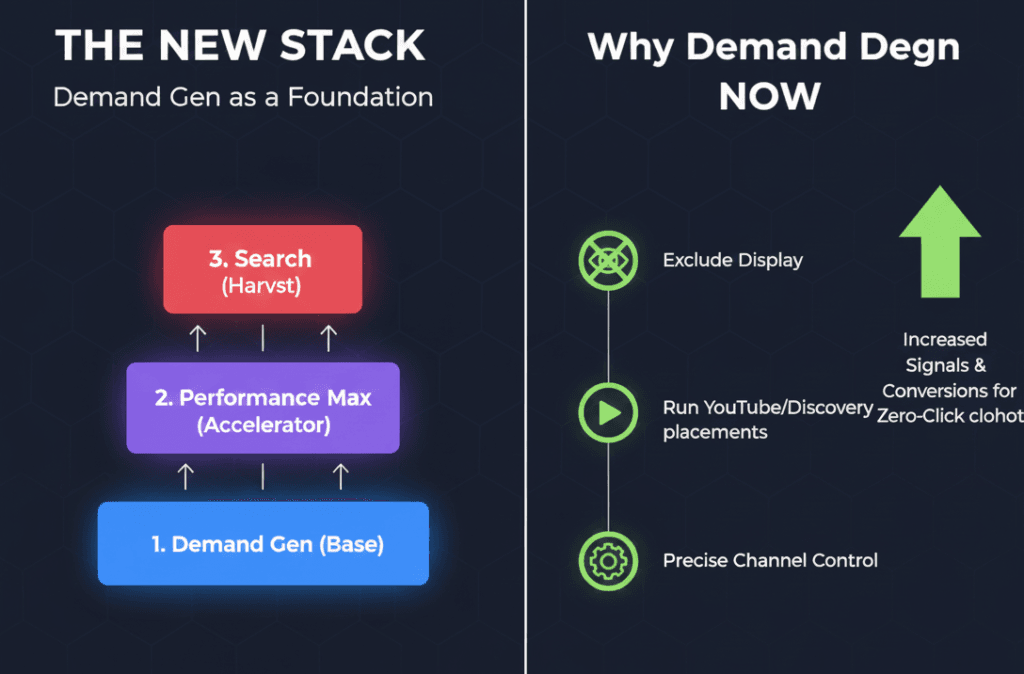
Historically, Discovery (now Demand Gen) was treated as a mid-funnel warmer, pushing users toward bottom-funnel search. For many verticals, search still works. However, we are observing a viable alternative stack:
- Run Demand Gen as the foundation.
- Layer in Performance Max as a secondary accelerator.
- Do not assume search must carry bottom-funnel performance.
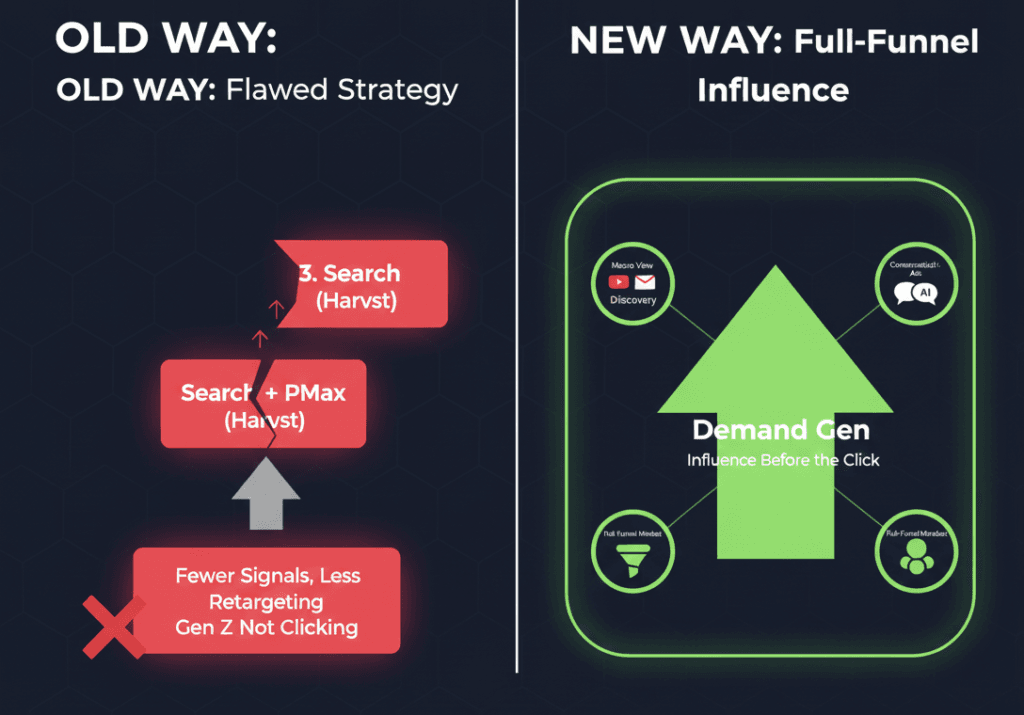
If Gen Z does not click search ads, there is little data to retarget. Performance Max then runs blind with fewer conversion signals to learn from. Demand Gen can fill that gap by creating consistent exposure and intent signals across owned Google surfaces.
Why Demand Gen Now
Recent Demand Gen controls matter. Advertisers can choose channels with precision:
- Exclude Display inventory.
- Run only Discovery placements.
- Run only YouTube if desired.
These controls were not available a few years ago. It suggests Google wants Demand Gen to function as a base campaign. Performance Max still prints the revenue for Google and remains useful, but Demand Gen is becoming the practical bridge between influence and conversion for a zero-click cohort.
Performance Max, Broad Match, and Practical Tradeoffs
Performance Max is here to stay and has grown more transparent, but it still handles too many surfaces at once without channel-level control. Search continues to work, but the economics incentivize broader automation. Exact and phrase often come with significantly higher CPCs, while broad plus smart bidding gets rewarded with quicker conversions. That does not negate search, but it reframes its role. Demand Gen increasingly absorbs functions previously divided across awareness, consideration, and remarketing.
The Strategic Takeaway
- Do not rely solely on search plus Performance Max. If Gen Z is not clicking, you have fewer signals to optimize against and fewer users to retarget.
- Treat Demand Gen as full-funnel, not just mid-funnel. Think of it like an influencer channel inside Google’s ecosystem, shaping perception before the click ever happens.
- Adopt a macro view. Blend your presence across what your target user sees, not just what they search in the moment.
- Anticipate conversational ad formats to deepen this trend. Google’s AI-driven conversations will meet users where they already are in their evaluation journey.
What To Do Next
- Use Demand Gen as the foundational campaign. Start with the placements that best fit your audience and creative, then expand.
- Layer Performance Max to capture and scale incremental demand. Let it harvest the intent your Demand Gen is creating.
- Use search selectively. Keep it for branded defense, high-intent clusters that still produce efficient CAC, and categories where search remains strong. Expect less from exact match and plan CPCs accordingly.
- Align measurement to the journey Gen Z actually takes. Expect more assisted conversions, view-through influence, and off-platform research before engagement.
Conclusion
Gen Z’s behavior has moved evaluation up the funnel and away from clicking traditional search ads as the default path. Google’s product direction reflects this shift. For performance marketers, the base campaign on Google is increasingly Demand Gen, with Performance Max layered in and search used deliberately. Mid-funnel is not mid-funnel anymore. It is where persuasion and proof happen. Building for that reality is how you stay effective as Gen Z takes the reins of evaluation and, soon, decision making.